Numverify Alternative: Why US-Focused Teams Switch to PilotLookup
PilotLookup Team
Author
In this article
- Why teams search for a Numverify alternative
- Where Numverify is the better choice
- Where PilotLookup fits better
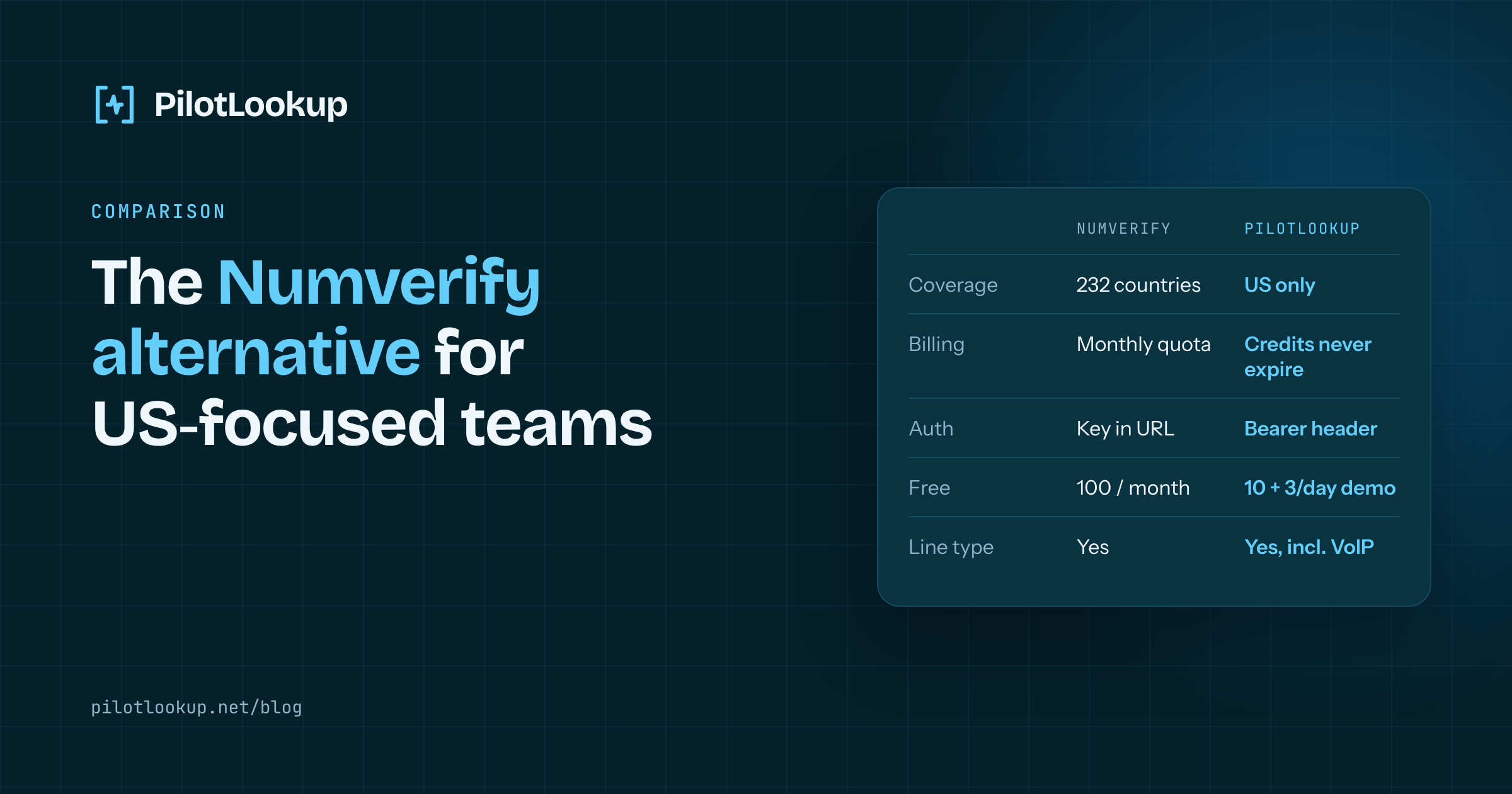
- Numverify vs PilotLookup: feature comparison
- Numverify pricing vs PilotLookup at real volumes
- Migrating from the Numverify API: field mapping and code
- Other Numverify alternatives worth a look
- FAQ
- Conclusion
1. Why Teams Search for a Numverify Alternative
If you are reading about a Numverify alternative, you probably already have Numverify wired into a signup form, a CRM sync, or an SMS pipeline. It works. It validates numbers, returns a carrier and a line type, and covers 232 countries. So why do teams go looking for something else?
In our conversations with developers, the reasons are rarely "Numverify is broken." They are usually about fit:
- Your traffic is almost entirely US numbers. You are paying for a global numbering-plan database while 98% of your lookups start with +1.
- Your volume is spiky. A product launch or a list import burns 40,000 lookups in a week, then the next month you need 2,000. Monthly quotas reset, so unused requests disappear.
- Security review flagged the auth method. The Numverify API takes its access key as a URL query parameter (
access_key=), which can end up in proxy logs, APM traces, and browser history. - The free plan cannot be used commercially. That makes it awkward for prototyping a real product.
This article is a fair head-to-head. We will show where Numverify is genuinely the better pick, where a US-focused phone validation API like PilotLookup fits better, what each option costs at real volumes, and exactly how to migrate if you decide to switch.
Competitor prices are published list prices as of mid-2026 and can change. Always verify current Numverify pricing on the APILayer site and PilotLookup pricing on our pricing page before you budget.
2. Where Numverify Is the Better Choice
A comparison that only lists one side's strengths is a sales page, not a comparison. Numverify has real advantages, and in some situations it is simply the right tool.
International coverage
Numverify validates numbers in 232 countries. PilotLookup covers US numbers only (the North American Numbering Plan). If your users are in Germany, Brazil, or India, PilotLookup is not the right tool, and we would rather tell you that up front. Our post on US vs international phone validation explains why the two problems are different.
A recurring free tier
Numverify's free plan gives you 100 requests every month. PilotLookup gives you 10 free lookups at signup (no credit card) plus a homepage demo with 3 lookups per visitor per day. If you need a small, recurring allowance for a hobby project, Numverify's free plan is more generous, as long as your use is non-commercial.
Low per-lookup cost at full monthly utilization
Numverify pricing is excellent when you use your full quota every month. The Enterprise plan is $129.99/month for 250,000 requests, which works out to about $0.00052 per lookup. That is lower than every PilotLookup pack, including Enterprise at $0.0006. Add Numverify's roughly 15–20% annual discount and the gap widens. If you run a flat, predictable 250,000 lookups every month, Numverify Enterprise is cheaper per lookup, full stop.
3. Where PilotLookup Fits Better as a Numverify Alternative
PilotLookup was built for one job: validate a US phone number and return its carrier, line type, and location in a single fast call. That focus produces a few concrete differences.
Credits that never expire
PilotLookup sells credit packs, not subscriptions. Buy 125,000 credits for $125 and they stay in your account until you use them, whether that is next week or next year. With a monthly quota, any requests you do not use in a given month are gone. For teams with campaign-driven or seasonal traffic, that difference often matters more than the headline per-lookup price. We go deeper on this in pay-as-you-go vs subscription pricing.
Bearer-token auth in a header
PilotLookup authenticates with Authorization: Bearer YOUR_API_KEY. Keys stay out of URLs, so they do not leak into access logs or analytics tools by default. The dashboard also lets you create scoped API keys and see per-key usage analytics, which helps when several services share one account.
Free trial with no commercial-use restriction
Your 10 free lookups can be run against your real production data and your real product. There is no "non-commercial only" clause to work around while you evaluate.
Rate limits that grow with your pack
PilotLookup rate limits are set by the largest pack you have bought, and they never drop: 30 requests/minute on Starter, 100 on Professional, 200 on Business, and 500 on Enterprise. Buy one Enterprise pack and you keep 500 req/min even after those credits run out and you top up with a smaller pack.
US-focused data and privacy
PilotLookup draws on 1.5M+ carrier records refreshed continuously from authoritative sources, including daily NPAC number portability updates, so ported numbers show their current carrier. PilotLookup reports 99.9% validation accuracy and a ~120ms median response time from edge infrastructure. Phone numbers are not stored or logged, traffic is protected with TLS 1.3, and the service is GDPR and CCPA compliant.
4. Numverify vs PilotLookup: Feature Comparison
Here is the numverify vs pilotlookup picture side by side, based on each vendor's published documentation.
| Feature | Numverify | PilotLookup |
|---|---|---|
| Coverage | 232 countries | US numbers only (NANP) |
| Pricing model | Monthly subscription, quota resets monthly | Credit packs, credits never expire |
| Free tier | 100 requests/month, non-commercial, no support | 10 lookups at signup, no card; 3/day homepage demo |
| Entry paid price | $14.99/mo for 5,000 | $25 one-time for 5,000 |
| Lowest list per-lookup | ~$0.00052 (Enterprise, full use) | $0.0006 (Enterprise pack) |
| Overage | Billed per extra request | None; buy another pack |
| Authentication | access_key in URL query string | Bearer token in Authorization header |
| Carrier | Yes | Yes, portability-aware |
| Line type | Yes | Yes (mobile, landline, voip, toll-free, unknown) |
| Location | Yes (location string) | Yes (city and state) |
| Live HLR reachability | Not advertised | No |
| Rate limits | Per plan | 30 / 100 / 200 / 500 req/min by largest pack |
| Data retention | See vendor policy | Numbers not stored or logged |
| Key management | Account access key | Scoped keys, per-key analytics, exportable logs |
Neither service returns a fraud risk score, caller name, or SIM-swap signal. If you need those, look at Twilio Lookup packages or a fraud-scoring vendor (see our Twilio Lookup alternative breakdown).
5. Numverify Pricing vs PilotLookup at Real Volumes
Per-lookup headlines hide the real story. What matters is what you pay for the lookups you actually run. Assumptions for the tables below: list prices, the cheapest Numverify plan that covers the monthly volume (overage is more expensive than upgrading in every case shown), monthly billing, and the cheapest PilotLookup pack combination that covers the volume.
Monthly view: one month at a time
| Lookups / month | Numverify plan | Numverify cost | Numverify $ per used lookup | PilotLookup cheapest purchase | PilotLookup cost |
|---|---|---|---|---|---|
| 5,000 | Basic | $14.99 | $0.0030 | 1 × Starter | $25 |
| 25,000 | Professional (50k quota) | $59.99 | $0.0024 | 1 × Professional | $75 |
| 50,000 | Professional | $59.99 | $0.0012 | 1 × Business (75k carry over) | $125 |
| 125,000 | Enterprise (250k quota) | $129.99 | $0.00104 | 1 × Business | $125 |
On a strict month-by-month basis, Numverify is cheaper at 5,000, 25,000, and 50,000. At 50,000, though, the PilotLookup purchase leaves 75,000 credits in your account for next month, which brings us to the fairer comparison.
12-month view: same volume every month
Because PilotLookup credits never expire, the sensible way to buy is to cover a year of volume with the cheapest pack mix. Numverify is shown at monthly billing; its annual billing would cut roughly 15–20% off these figures.
| Lookups / month | Annual volume | Numverify (12 × monthly) | PilotLookup pack mix | PilotLookup cost |
|---|---|---|---|---|
| 5,000 | 60,000 | $179.88 | 1 × Business (65k left over) | $125 |
| 25,000 | 300,000 | $719.88 | 1 × Enterprise (200k left over) | $300 |
| 50,000 | 600,000 | $719.88 | 1 × Enterprise + 1 × Business | $425 |
| 125,000 | 1,500,000 | $1,559.88 | 3 × Enterprise | $900 |
| 250,000 | 3,000,000 | $1,559.88 | 6 × Enterprise | $1,800 |
The last row is the honest one: at a steady 250,000 lookups per month, Numverify Enterprise wins ($1,559.88 at monthly billing, roughly $1,248–$1,326 with an annual discount, versus $1,800). Below that, PilotLookup's non-expiring packs come out ahead because you never pay for unused quota. One caveat on the 5,000-per-month row: buying a Starter pack every month instead would cost $300 per year, more than Numverify. Buying a larger pack once is what makes PilotLookup cheaper.
The spiky-usage scenario
Now take a realistic growth-team pattern: two campaign months at 40,000 lookups each and ten quiet months at 2,000 each. That is 100,000 lookups per year.
| Approach | How it is bought | Annual cost | Paid-for lookups wasted |
|---|---|---|---|
| Numverify, stay on Professional all year | 12 × $59.99 | $719.88 | 500,000 |
| Numverify, switch plans perfectly each month | 2 × Professional + 10 × Basic | $269.88 | 50,000 |
| PilotLookup | 1 × Business pack | $125 | 0 (25,000 credits carry into next year) |
Even with perfect plan switching, which nobody actually does, the monthly-quota model costs more than double here. This is the pattern where a Numverify alternative with non-expiring credits pays off most. For a broader vendor-by-vendor breakdown, see our phone validation API pricing comparison.
If you use close to 100% of a Numverify plan every single month, stay put or move to annual billing. If your usage swings by more than about 2× month to month, or you only need US numbers, run the numbers on non-expiring credits.
6. Migrating from the Numverify API: Field Mapping and Code
Switching a phone validation API is usually a one-file change. The main work is mapping response fields and updating any code that reads them.
Response field mapping
| Numverify field | PilotLookup field | Notes |
|---|---|---|
valid | valid | Same meaning: boolean. |
intl_format | phone | PilotLookup returns E.164, e.g. +12032145454. |
local_format | Derive from phone | Strip the leading +1 to get the 10-digit national number. |
country_code | None | Always US; set "US" in your adapter if downstream code expects it. |
location | city + state | Two structured fields instead of one string. |
carrier | carrier | Current carrier, portability-aware. |
line_type | line_type | Values: mobile, landline, voip, toll-free, unknown. Note the hyphen in toll-free; check any stored values that used underscores. |
Before: Numverify (Node.js)
numverify.js// Access key travels in the URL query string
async function validatePhone(number) {
const url = `https://apilayer.net/api/validate?access_key=${process.env.NUMVERIFY_KEY}` +
`&number=${encodeURIComponent(number)}&country_code=US`;
const res = await fetch(url);
const data = await res.json();
return {
valid: data.valid,
e164: data.intl_format,
national: data.local_format,
location: data.location,
carrier: data.carrier,
lineType: data.line_type
};
}After: PilotLookup (Node.js)
pilotlookup.js// Bearer token in a header; same return shape for downstream code
async function validatePhone(number) {
const digits = String(number).replace(/\D/g, '').replace(/^1(?=\d{10}$)/, '');
const res = await fetch(
`https://www.pilotlookup.net/api/validate?phone=${encodeURIComponent(digits)}`,
{ headers: { Authorization: `Bearer ${process.env.PILOTLOOKUP_API_KEY}` } }
);
if (!res.ok) throw new Error(`PilotLookup error ${res.status}`);
const data = await res.json();
return {
valid: data.valid,
e164: data.phone,
national: data.phone ? data.phone.replace(/^\+1/, '') : null,
location: [data.city, data.state].filter(Boolean).join(', '),
carrier: data.carrier,
lineType: data.line_type
};
}Keeping the same return shape means the rest of your codebase does not change. Our guide to phone validation API endpoints and response fields covers error handling, retries, and caching in more depth.
A safe migration checklist
- Create a PilotLookup account and use your 10 free lookups on numbers you already validated with Numverify.
- Compare
valid,carrier, andline_typeon that sample, especially recently ported numbers. - Ship the adapter behind a feature flag and route a small share of US traffic to it.
- Keep Numverify for any non-US numbers if you have them; route by the
+1prefix. - Cut over fully and let your Numverify plan lapse at the end of its billing period.
PilotLookup only validates US numbers. If even a small slice of your users enter international numbers, keep a global provider for those and send only +1 numbers to PilotLookup.
7. Other Numverify Alternatives Worth a Look
PilotLookup is not the only Numverify alternative. Depending on your needs, one of these may fit better:
| Provider | Coverage | Free tier | Pricing model | Stands out for |
|---|---|---|---|---|
| PilotLookup | US only | 10 lookups at signup | Non-expiring credit packs, from $25 | US teams, spiky volume, Bearer auth, no data retention |
| Abstract API | 195+ countries | 100 requests/mo | Monthly subscription from $19/mo | Timezone data; risk data on higher tiers |
| Veriphone | 240+ countries | 1,000 credits/mo | Credits from ~$0.0002 at the largest pack; live current-carrier lookup costs 10 credits | Built-in bulk CSV, non-expiring pay-as-you-go credits |
| Twilio Lookup v2 | Global | Basic formatting free | Per request, per package; Line Type Intelligence $0.008 | Fixed vs non-fixed VoIP split, SIM swap, caller name, SMS pumping risk |
For the full field of nine providers, read Best Phone Validation APIs in 2026. Verify current pricing on each vendor's site before deciding.
8. FAQ
Is PilotLookup a drop-in Numverify alternative?
For US numbers, nearly. Both return valid, carrier, and line_type. You will map intl_format to phone, split location into city and state, and move the API key from the URL into an Authorization header. Most teams finish the change in one small pull request.
Is Numverify pricing cheaper than PilotLookup?
At full, steady monthly utilization, yes: Numverify Enterprise works out to about $0.00052 per lookup versus $0.0006 for PilotLookup's Enterprise pack. When usage varies month to month, or sits well below a plan's quota, PilotLookup's non-expiring credits usually cost less over a year.
Can I use PilotLookup for international numbers?
No. PilotLookup validates US (NANP) numbers only. For international numbers, use a global provider such as Numverify, Abstract API, Veriphone, or Twilio Lookup.
Does PilotLookup return a fraud score or caller name?
No. PilotLookup returns phone, valid, carrier, line_type, city, and state. Teams typically use line_type (for example, flagging voip) as a fraud signal inside their own rules.
What happens to my rate limit when credits run low?
Nothing. Your rate limit is set by the largest pack you have ever bought and never drops, so a team that bought an Enterprise pack keeps 500 requests per minute.
9. Conclusion
Numverify is a capable phone validation API, and for global coverage or a flat, fully used monthly volume it remains a strong choice. The best Numverify alternative for you depends on fit: if your traffic is US-only, your volume is uneven, or your security team wants API keys out of URLs, PilotLookup gives you portability-aware carrier and line type data, credits that never expire, and a simple single-call response. Run your own numbers with the tables above, test on your real data with the free lookups, and decide with evidence. You can compare plans on our pricing page or browse the full feature list.
Test PilotLookup against your Numverify results
Get 10 free US lookups with no credit card, run them on numbers you already know, and compare carrier and line type side by side.
Get Your Free API Key →See pricing · support@pilotlookup.net · 1-888-370-6801